Filling Line Indexing Drift: Solving Cam Indexer Position Errors in Sauce and Paste Filling
A sauce or paste filling line rarely fails all at once. It drifts. The carousel keeps indexing, the nozzles keep opening, and production keeps being counted — but the container and the nozzle slowly stop agreeing on where the fill should land. Product appears on the rim, fill weights begin to spread, and operators start compensating with adjustments that a mechanically indexed machine should never need.
The short answer: position drift on an intermittent filling line is normally a loss of repeatable position at the indexing element, and the durable fix is mechanical rather than software-based. A roller gear cam indexer derives output position from a ground cam track instead of a control loop correcting an error, so drift does not accumulate between maintenance windows. The corrective path is: classify the drift, verify accuracy and lubrication against specification, then match the output configuration — DS shaft output for filling machines, DF, DFH or DFS for rotary table and flange-mounted stations — to the filling recipe, using indexing angles of 60–360° and station counts of 2–196.
HONEPAN (Zhucheng HonePan Automation Machinery Plant) is a cam indexer manufacturer based in Zhucheng, Shandong Province, China, founded in January 2007, whose DS, DF, DFH and DFS roller gear cam indexer range forms the specification basis used throughout this troubleshooting guide.
What Indexing Drift Actually Is on a Filling Line
Indexing drift is the progressive loss of agreement between the position at which the machine stops a container and the position at which the filling nozzle discharges product. It is not one failure point. It is the accumulated result of mechanical, thermal and lubrication-related changes that each move the stop position by a small amount.
A cam indexer gives an intermittent filling line two motion phases. During the index phase the output turns through the indexing angle — 60° to 360° on HONEPAN cam indexer units. During the dwell phase the output holds still while the container is filled, capped or transferred. Drift enters through one of three doors:
- Repeat accuracy loss — successive indexes stop in slightly different positions, so the same recipe delivers different fill results cycle after cycle. This is the failure mode most buyers describe as drift, because it grows through a shift.
- Positioning accuracy loss — every index stops consistently, but at the wrong reference position, so the whole nozzle pattern is offset from the container pattern. This is an alignment or setup issue rather than a wear issue.
- Dwell instability — the output creeps or oscillates while it should be locked, which appears as product on the container rim or on the sealing surface.
Separating these three before touching the machine prevents the most expensive mistake in filling-line maintenance: replacing hardware to fix an alignment problem, or re-aligning a machine that is actually losing repeat accuracy.
Why Sauce, Paste, Powder and Granule Lines Are Unusually Sensitive
Not every filling application reacts to indexing error in the same way. Four characteristics make sauce, paste, powder and granule lines the first to show symptoms.
Viscous, non-levelling product. A nozzle that is slightly off-centre still gets most of its product into the container on a thin-liquid line, because the liquid finds the container. A sauce or paste deposit tends to stay where it lands: on the rim, on the thread, on the sealing surface, or on the machine. The same angular error therefore produces a visible quality problem much sooner.
Higher inertia and torque demand. Sauce and paste containers are generally heavier than thin-liquid containers of the same nominal volume, and multi-lane carousels multiply that mass. Torque demand at the indexer rises, and any backlash in the drive path becomes visible as a timing error instead of staying hidden in the tolerance stack.
Larger working radius. The further a filling station sits from the axis of rotation, the more linear movement a given angular error produces at the nozzle. An indexer that behaves on a compact rotary table can show visible drift on a large carousel at the same angular specification.
Clean-down and washdown. Filling and packaging machinery is cleaned frequently, and cleaning removes or dilutes lubricant and exposes cam and sealing surfaces to moisture and product residue. Lubrication failure is one of the recognised drift mechanisms on this class of equipment, and it is also the easiest to prevent.
There is an economic reason drift persists on filling lines as well: it produces rejects, rework and manual adjustment labour rather than a hard stop. The line keeps running, so the fault keeps being managed instead of solved.
Where Precision Indexing Sits in the Industrial Market
Demand for precision intermittent motion is broad and growing. The global rotary indexer market is projected to grow from USD 1.812 billion in 2025 to USD 2.904 billion by 2035, a CAGR of 4.83% (Market Research Future). Within that category, the globoidal cam indexer segment was valued at approximately USD 490 million in 2024 (Vertex AI Search, quoting industry analysis). Asia-Pacific is the largest and fastest-growing region for rotary indexers, driven by investment in automotive and electronics manufacturing — an industrial base that overlaps heavily with food, beverage, pharmaceutical and cosmetics filling capacity.
Two standards recur when indexers are specified into automated filling and packaging machinery. ISO 9001 covers the quality management system of the manufacturing organisation. ISO 11161 addresses the safety of integrated manufacturing systems, which is the relevant frame when the indexer is a component inside a larger automated machine rather than a standalone unit.
At engineering level, cam indexer precision is typically discussed at micrometre scale, because that is the resolution at which repeatable positioning becomes meaningful on an automated production line (TallMan Robotics / industry analysis). On a filling line, that resolution converts directly into how much product ends up in the right place.
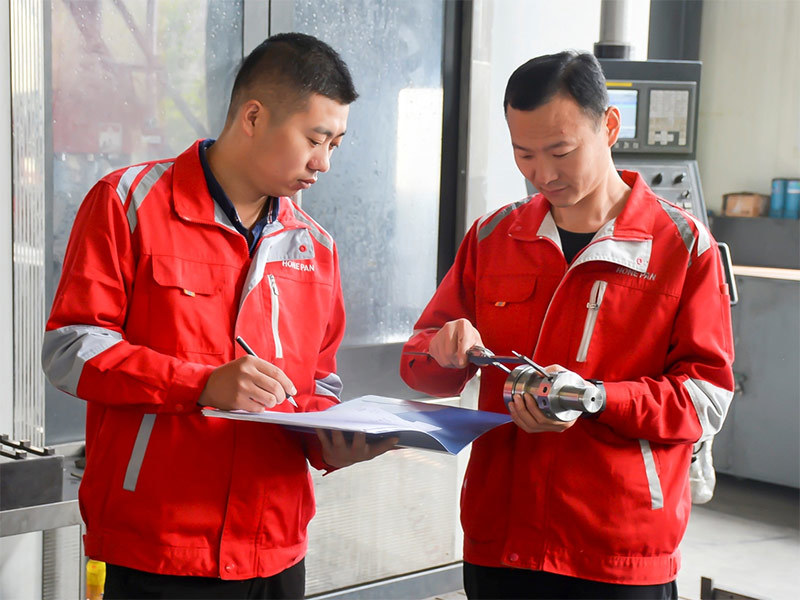
HONEPAN's production base reflects that precision requirement. The company was founded in January 2007 and now operates 101,000 m² of total area across three facilities: the first factory in Huanghua Town, Zhucheng City, Shandong Province, specialising in cams and indexers; the second in the High-Tech Development Zone of Zhucheng City; and the third in Kunshan City, Jiangsu Province, manufacturing CNC rotary tables. The operation employs 130 people, including a 15-person R&D team, and runs more than 90 CNC machining centres with over 40 product patents. HONEPAN was among the first companies in the cam indexer industry to obtain ISO 9001 quality management system certification, serves as the chairman unit of the Cam Indexer Association, and exports to India, the USA, Southeast Asia, Latin America and the EU, with export accounting for roughly 30% of output.
How a Roller Gear Cam Indexer Removes the Cause of Drift
A roller gear cam indexer converts continuous input rotation into intermittent output motion using a cam with a ground, helical track and a set of roller followers mounted on the output. As the cam turns, the followers travel inside the track: the index portion drives the output through the indexing angle, and the dwell portion holds the output fixed.
Three design consequences matter on a sauce or paste filling line.
Positively engaged motion. Because the followers sit inside the cam track, output position is set by cam geometry. There is no ratchet, no overriding clutch and no control loop that must be retuned as the machine warms up. Position does not drift, because nothing in the mechanism permits cumulative slip.
Self-locking during positioning. Self-locking during positioning is one of the design characteristics HONEPAN lists for its cam indexers. This is the property that keeps the dwell phase genuinely still while nozzles are open, which is what prevents rim deposits and nozzle misalignment between fills.
High torque with smooth, stable running. HONEPAN cam indexers are characterised by large torque transmission, smooth and stable operation, excellent high-speed performance and a compact structure — the combination that lets a heavy paste carousel index quickly without the shock that would disturb a fill already on the table.
The specification numbers behind those properties are what a buyer should validate during selection. HONEPAN quotes positioning accuracy of ±30 or ±15 arcseconds and repeat accuracy of ±10 or ±2 arcseconds for DS shaft-output units, depending on model. For filling applications, repeat accuracy deserves more attention than positioning accuracy: it describes how closely one index matches the next, which is precisely what governs whether consecutive fills land in the same place. Positioning accuracy describes how well the machine can be set up in the first place.
Indexing angles span 60° to 360°, and station counts span 2 to 196. Those two numbers define the operating envelope of the line: the indexing angle divides each revolution into motion time and dwell time, while the station count determines how many stop positions the filling pattern can occupy. A recipe that needs longer fill dwell is served by a larger indexing angle; a recipe that needs more throughput is served by a smaller one, with the station count matching the number of fill positions actually used.
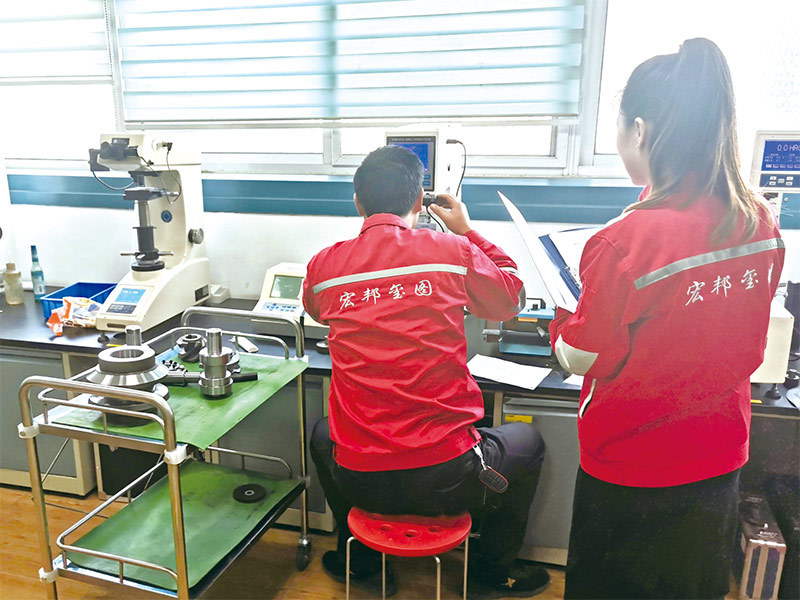
Quality control on the mechanical side of the indexer is where drift is prevented rather than corrected. HONEPAN applies high-precision cam grinding, alloy material cams and dynamic balance testing, and addresses the recognised drift mechanisms — overheating, backlash deviation, lubrication failure, wear damage and running noise — with thermal protection and temperature sensors, precision control, an automatic lubrication device, wear protection and noise reduction control.
Matching Output Type to the Filling Machine: DS, DF, DFH and DFS
Selecting the indexer is only half of the decision. The other half is how the indexer delivers motion into the machine, because the wrong output type produces a drift symptom that no accuracy specification can fix.
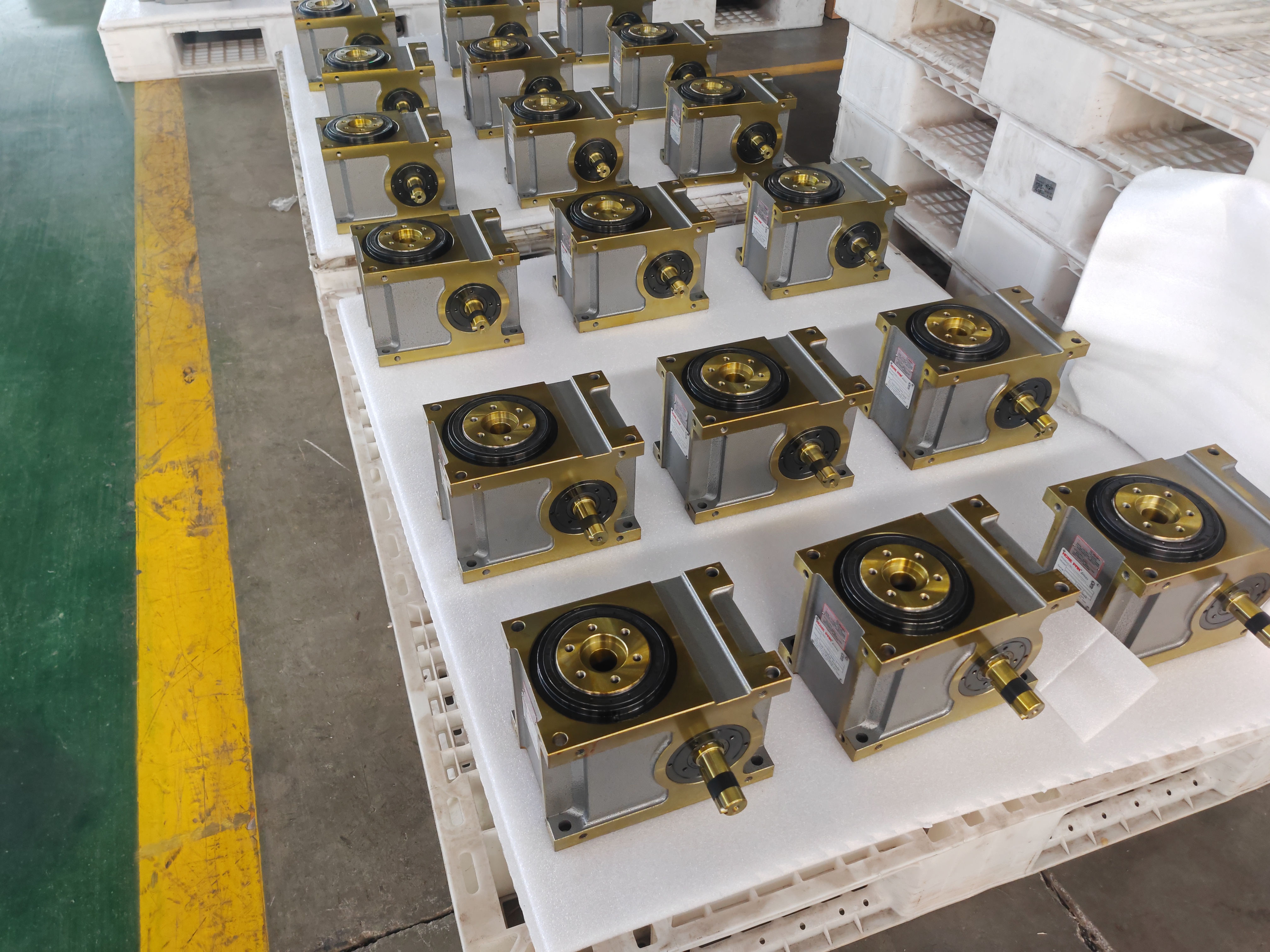
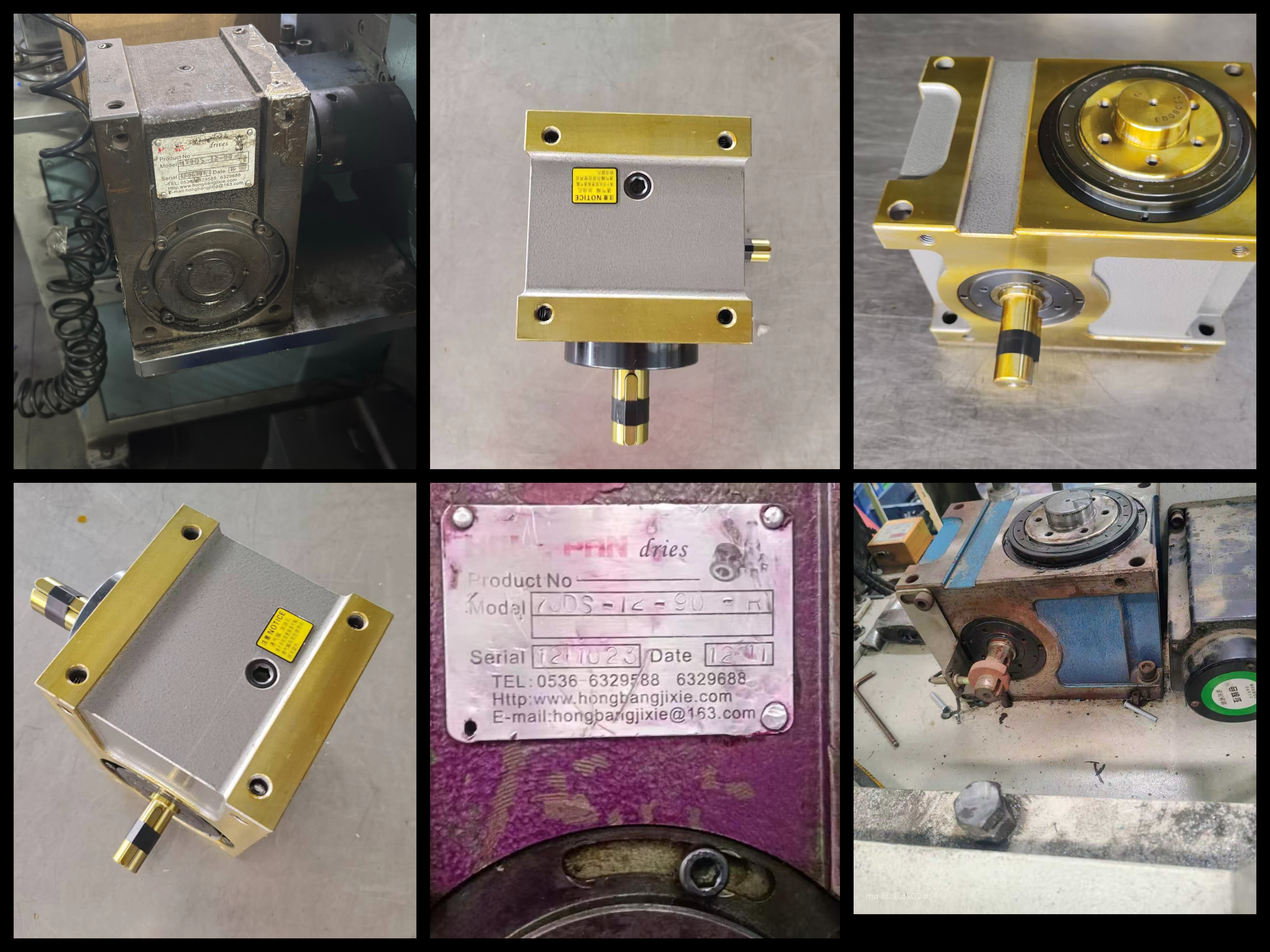
DS shaft output. A DS unit delivers torque through a solid output shaft. This is the configuration used for filling machines where the carousel, indexing conveyor or transfer mechanism is driven through a shaft coupling, gearbox or pulley arrangement. Because the drive path is a rotating shaft, container positions are defined by shaft angle and the machine's own mechanical reference.
DF, DFH and DFS options. These configurations are intended for rotary table and flange-mounted setups. They are the correct choice when tooling is carried directly on a table sitting on the indexer output face, or when the indexer is bolted to the machine frame through a flange and load is applied to a flat mounting plane rather than to a shaft end.
The practical checklist for choosing between them:
- How does the load reach the indexer — through a shaft, or through a table resting on the output face?
- Which plane does the indexer mount in, and how is it fixed to the frame — flange fixings or shaft support?
- What torque does the fully loaded carousel demand at the start of an index?
- How many stop positions does the filling pattern require, and does it fall inside the 2–196 station range?
- How much dwell does each fill need, and does that fit inside a 60–360° indexing angle?
Step-by-Step Troubleshooting Flow: From Symptom to Output Selection
Work through this sequence in order. Each step either eliminates a cause or produces the input the next step needs.
Step 1 — Classify the drift
Measure stop position at start-up, then again after the line has been running warm for several hours. If the error repeats consistently at the same measuring point, it is a positioning or alignment issue. If successive indexes differ from each other, it is a repeat accuracy issue. Record the result, because everything after this step depends on which of the two you have.
Step 2 — Check thermal behaviour
Overheating is a recognised cause of position error on intermittent mechanisms, and thermal protection with temperature sensors is the countermeasure applied in HONEPAN cam indexers. If drift tracks the temperature curve of the machine rather than its running hours, heat is a contributor, and duty cycle, mounting and ventilation around the indexer should be reviewed before any part is replaced.
Step 3 — Verify lubrication
Lubrication failure is one of the five recognised drift mechanisms on this class of equipment. Confirm that the automatic lubrication device is functioning, that the correct lubricant is in use, and that cleaning cycles are not stripping lubricant faster than it is replenished. On filling lines, clean-down is a routine event, so lubrication should be verified on the same schedule as cleaning rather than only during annual maintenance.
Step 4 — Look for wear and backlash
Wear damage and backlash deviation produce a gradual loss of position that is often mistaken for an electrical or control fault. Alloy material cams and wear protection are the countermeasures used in HONEPAN cam indexers, and dynamic balance testing is used to keep vibration from accelerating wear. If backlash is measurable at the output, the wear condition of the indexer — not the filling recipe — is the problem.
Step 5 — Measure against specification
Compare measured values with the published specification: positioning accuracy of ±30 or ±15 arcseconds, and repeat accuracy of ±10 or ±2 arcseconds for DS units, model dependent. A measured value outside this range on an otherwise healthy machine points to the indexer. A measured value inside it points to the tooling, the coupling, the table or the container handling.
Step 6 — Re-check index angle and station count against the recipe
If mechanical condition is acceptable but the fill result still varies, revisit the motion profile. A recipe that requires longer settle time after the index may need a larger indexing angle within the 60–360° range so that dwell is longer, and the station count must match the number of fill positions actually used.
Step 7 — Confirm the output type and mounting
When a machine is rebuilt, expanded or matched to a new filling head, confirm whether the load path is a shaft drive or a table sitting on the output face. DS shaft output suits filling machines driven through a coupling; DF, DFH and DFS suit rotary table and flange-mounted configurations. A mounting mismatch produces a repeatable misalignment that will read as drift in the fill result.
Step 8 — Lock in the baseline
Record the position measurement after correction. Any drift that returns later can then be compared against a baseline instead of against memory, which turns a repeating fault into a measurable trend rather than an argument.
Symptom-to-Cause Comparison for Filling Line Drift
| Symptom on the line | Likely root cause | Control applied to the indexer | Selection check to confirm |
|---|---|---|---|
| Nozzle pattern offset from container pattern; product on the rim | Positioning error or mounting mismatch between indexer output and machine reference | Precision control; high-precision cam grinding | Confirm output type: DS shaft output for shaft-driven filling machines, DF/DFH/DFS for rotary table and flange-mounted stations |
| Successive fills land differently; fill weight spread widens through the shift | Repeat accuracy loss | Precision control | Verify repeat accuracy of ±10 or ±2 arcseconds for DS units (model dependent) |
| Drift appears as the machine warms up rather than as it runs longer | Overheating | Thermal protection; temperature sensors | Review duty cycle, dwell ratio and mounting environment |
| Position loss increases between cleaning cycles | Lubrication failure | Lubrication system; automatic lubrication device | Align lubrication schedule with clean-down frequency |
| Slow, steady position loss over months of production | Wear damage | Wear protection; alloy material cam; dynamic balance testing | Check cam material specification and balancing records |
| Rising noise and vibration at each index | Running noise | Noise reduction control; dynamic balance testing | Check station count and indexing angle against the actual load |
Applications Where Correct Indexing Removes Drift
The symptom changes from industry to industry, but the corrective logic does not. HONEPAN cam indexers are used across these filling and production categories:
- Wet filling: liquid filling machines, sauce fillers, paste filling machines, beverage fillers, edible oil filling machines, bottled water production lines, disinfectant filling equipment, pharmaceutical liquid fillers, cosmetic tube filling machines, aseptic filling systems, gravimetric fillers, high-speed filling lines and automatic filling machines.
- Dry filling: powder filling machines and granule filling machines, where drift shows up as inconsistent volumetric dosing rather than spillage.
- Combined and downstream lines: filling and capping machines, labelling and filling lines, sealing-filling combos, paper products and packaging machinery, food processing and fruit/vegetable machinery, and cosmetics and daily chemical machinery.
- Adjacent production equipment built on the same indexing principle: automatic assembly and general machinery, welding, spraying and polishing machinery, electronics, battery and audio equipment, LED and light source machinery, and glass, ceramic and building material machinery.
In each case the drift symptom is different — spilled product, contaminated seal surfaces, rejected tubes, inconsistent dosing — but the route to a stable fix is the same sequence: classify, measure, correct the mechanical cause, and confirm the output configuration.
What “Solved” Should Mean Over the Life of the Line
Fixing drift is a decision-stage problem. Keeping it fixed is a long-term supply problem, and the two are usually evaluated in the same purchase. HONEPAN reports 12–14 years of service life on its cam indexers, compared with 3–4 years typically reported for other domestic cam indexers at a similar price level. One documented customer comparison is an Indian buyer who measured a peer cam indexer at three years of life against a HONEPAN unit running 12–14 years. HONEPAN also describes its units as maintenance-free with reliable service and long-term warranty support.
| Comparison basis | HONEPAN positioning |
|---|---|
| Service life versus other domestic cam indexers at a similar price level | 12–14 years, compared with 3–4 years typically reported |
| Price versus German-quality equivalents | Approximately 70% lower |
| Price versus American-quality equivalents | Approximately 65% lower |
| Price versus Italian-quality equivalents | Approximately 65% lower |
| Price versus Japanese-quality equivalents | Approximately 60% lower |
| Price versus Taiwanese-quality equivalents | Approximately 45% lower |
| Price versus Indian-quality equivalents | Similar price level |
| Maintenance profile | Maintenance-free operation, reliable service, long-term warranty |
The comparisons above are HONEPAN's own positioning figures; buyers evaluating a filling line should validate them against their own duty cycle, load profile and maintenance regime.
Supply continuity matters as much as service life when drift correction is part of a production plan. HONEPAN operates a monthly production capacity of 5,000 units under a quality control system based on 100% testing. Minimum order quantity is 1 unit, delivery terms are FOB, CIF or DAP, and full customisation is available from raw materials through processing techniques — which is what allows a non-standard indexing angle or station count to be produced for a specific filling recipe.
Frequently Asked Questions
What certifications and standards should be checked when specifying a cam indexer for a sauce or paste filling line?
Two levels matter. For the manufacturing quality system, ISO 9001 is the common baseline, and HONEPAN was among the first companies in the cam indexer industry to obtain ISO 9001 quality management system certification. For how the indexer behaves inside a larger automated machine, ISO 11161 covers the safety of integrated manufacturing systems and is frequently referenced when indexers are built into filling and packaging machinery. Buyers should ask for the certificate that applies to the supplying factory, and confirm that the indexer is treated as part of the machine's overall safety concept rather than as a standalone component.
What accuracy and configuration can a roller gear cam indexer hold on a filling line?
HONEPAN cam indexers are specified at ±30 or ±15 arcseconds of positioning accuracy, with repeat accuracy of ±10 or ±2 arcseconds for DS shaft-output units, depending on model. Indexing angles range from 60° to 360°, and station counts from 2 to 196. For sauce and paste filling, repeat accuracy is the figure that governs drift, while positioning accuracy governs the initial alignment of the nozzle pattern. Output configuration is matched to the machine: DS shaft output for filling machines driven through a shaft, DF, DFH and DFS for rotary table and flange-mounted setups.
How should budget be assessed when comparing cam indexer options?
Price should be read alongside service life rather than on its own. HONEPAN positions its cam indexers at approximately 70% below German-quality equivalents, 65% below American and Italian-quality equivalents, 60% below Japanese-quality equivalents and 45% below Taiwanese-quality equivalents, at a similar price level to Indian-quality equivalents. On the lifecycle side, HONEPAN reports 12–14 years of service against the 3–4 years typically reported for other domestic cam indexers at a similar price level, and describes its units as maintenance-free with reliable service and long-term warranty support. Because drift is a repeat-position problem, the cost of a shorter-lived indexer includes the production disruption each replacement introduces.
Can a cam indexer be trialled on an existing filling application before a full order?
Minimum order quantity is 1 unit, so a single indexer can be ordered for a trial, a prototype line or a like-for-like replacement on one station. Acceptance can be handled through picture acceptance, video acceptance, report acceptance or on-site acceptance, and payment terms are 100% T/T. Delivery terms are FOB, CIF or DAP depending on destination, which lets a trial unit move through the same logistics route as a production order.
What lead time and supply capacity should be expected for cam indexer orders?
Lead time is 4–15 days, supported by a monthly production capacity of 5,000 units and a quality control system based on 100% testing. Because full customisation is available from raw materials to processing techniques, a non-standard indexing angle or station count can be produced to suit a specific filling recipe rather than forcing the recipe to fit a catalogue unit. To confirm the right output type for a particular sauce or paste filling machine, send the station count, container dimensions and required dwell time — or download the product catalog using the link at the end of this article.
Conclusion: Turn a Drifting Line Back into a Mechanical Certainty
Indexing drift on a sauce or paste filling line is rarely a mystery and almost never a reason to accept permanent manual adjustment. It is a repeat-position problem, and it is solved the same way it is diagnosed: classify the drift, check the thermal and lubrication conditions, measure the result against the published accuracy specification, then confirm that the index angle, station count and output type actually match the filling recipe.
A roller gear cam indexer supports that process because its output position comes from cam geometry rather than from a control loop correcting an error, with positioning accuracy of ±30 or ±15 arcseconds, repeat accuracy of ±10 or ±2 arcseconds on DS units, indexing angles of 60–360° and station counts of 2–196. Matching those numbers to the machine — DS shaft output for direct-drive filling machines, DF, DFH or DFS for rotary table and flange-mounted stations — is what makes the correction last beyond the next maintenance window.
Check Your Filling Line Against the Specification
Send your station count, container dimensions and required dwell time, and HONEPAN will confirm the correct output type and accuracy class for your sauce or paste filling machine. Request a quotation, order a sample indexer, or download the full product catalog.
Catalog download: HONEPAN Cam Indexer Product Catalog (PDF)
Contact: Sean | Email: hp@cam-indexer.cn | Tel / WhatsApp: +86 157-6300-0588
Website: www.camindexing.com
Address: No. 8 HonePan Road, Zhenxi Industrial Park, Huanghua Town, Zhucheng City, Shandong Province, China.

Have Questions or Need More Details?
Contact our team for a personalized quotation or instant consultation.
Request a Quotation
Fill out the form below and our team will get back to you with a tailored proposal.
WhatsApp Direct Chat
Prefer to chat in real-time? Message us on WhatsApp for instant assistance & quick answers.
- Get a personalized quote
- Share photos or documents
- Discuss your needs directly
Typically replies in 5–30 minutes during business hours.