
Cam Indexer Output Types for Packaging, Filling, and Assembly: A Scenario-Based Selection Guide
Cam Indexer Output Types for Packaging, Filling, and Assembly: A Scenario-Based Selection Guide
Selecting the right cam indexer for an automation project is usually less about brand preference and more about matching the output configuration to the machine's mechanical layout. The output type — shaft, flange, hollow flange, table, ultra-thin table, heavy-duty barrel cam, or parallel — determines how the indexer connects to the load, how much space it occupies, whether pipes or cables can pass through the center, and how stable the indexing motion will be over a long production run.
For packaging, filling, and assembly machinery, the correct starting point is the application scenario: how many stations the machine needs, what indexing angle matches the cycle, how the worktable or conveyor is supported, and whether the process requires food-grade, heavy-load, high-speed, explosion-proof, or leak-proof conditions. This guide explains how to map these project conditions to the main cam indexer series manufactured by HONEPAN.
Why Application Matching Defines Cam Indexer Performance
In real production lines, the cam indexer is a core functional component, not an optional gearbox. A mismatch between the indexer output type and the machine structure can appear as poor positioning, container spillage, capping misalignment, uneven welding seams, or premature wear after months of operation.
Common project-level mismatches include:
- Using a shaft-output cam indexer on a rotary table machine and adding a separate support frame, which increases inertia, reduces rigidity, and complicates center-height alignment.
- Choosing a closed flange type when the filling or capping machine needs pneumatic lines, electrical cables, or product pipes to pass through the center.
- Selecting a standard table indexer for a heavy welding positioner or large-diameter turntable, which can lead to excessive table deflection and production stoppages.
- Ignoring the relationship between indexing angle and dwell time, which directly limits the machine's achievable cycles per minute.
The practical method is to define the machine cycle first — station count, indexing angle, load path, working height, and service environment — and then choose the output series that fits those conditions.
Industry Background: Cam Indexers in Automated Production
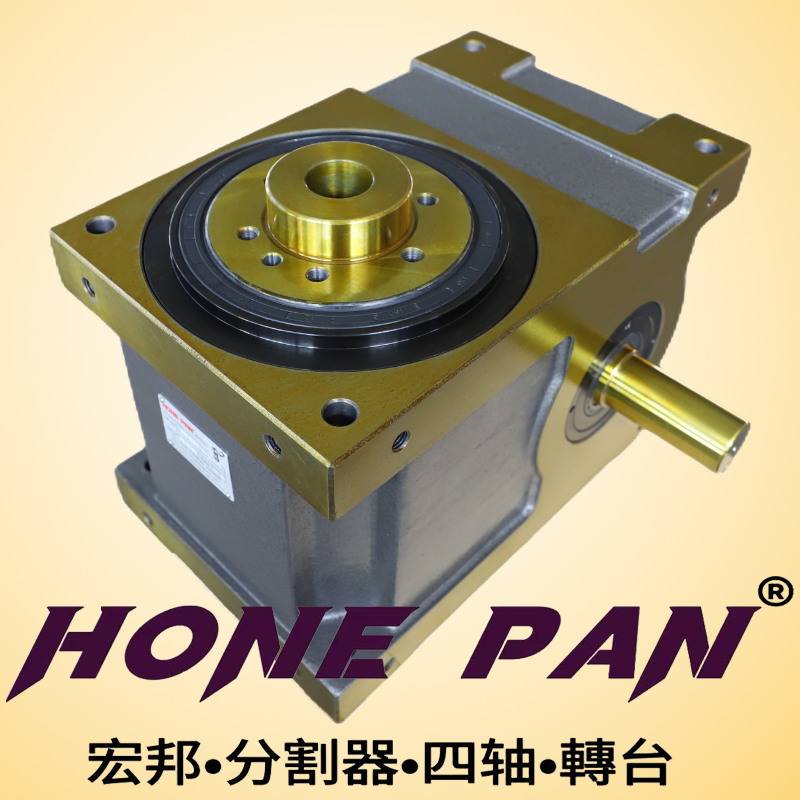
Cam indexers convert continuous input rotation into intermittent stepping motion. HONEPAN products are described as ideal transmission mechanisms for automated equipment that requires continuous operation to be turned into stepping motion with continuous, stable, high-torque transmission and self-locking during positioning.
HONEPAN, established in January 2007, operates from a total area of 101,000 m² and produces about 36,000 cam indexers per year. The company employs 130 people, operates more than 90 CNC machining centers, holds over 40 product patents, and was among the first in the cam indexer industry to obtain ISO 9001 quality management system certification. It serves as the chairman unit of the Cam Indexer Association and is recognized as a high-tech enterprise.
HONEPAN cam indexers are widely applied in automotive welding lines, positioners, CNC machine tools, pharmaceutical machinery, printing machinery, food packaging and filling machinery, tobacco machinery, glass and ceramic machinery, automatic feeding mechanisms, automatic tool-changing mechanisms, electronic and electrical assembly and testing lines, LED equipment, spraying equipment, bottle cap equipment, and welding, riveting, and high-frequency equipment.
Market demand for indexing components continues to grow. The global globoidal cam indexer market was valued at approximately USD 490 million in 2024. The rotary indexer market is projected to grow from USD 1.812 billion in 2025 to USD 2.904 billion by 2035, at a CAGR of 4.83%. Asia-Pacific is the largest and fastest-growing regional market, supported by investment in automotive and electronics manufacturing.
Detailed Solution: Matching Cam Indexer Output Series to Machine Scenarios
HONEPAN's standard cam indexer range covers multiple output configurations. For a packaging, filling, assembly, welding, or conveying project, the selection logic starts with three questions: Where is the load mounted? Does the center need to be open? What indexing cycle is required?
Shaft Output (DS Series)
The DS series uses a shaft output and is suitable when the indexer needs to connect to a gear, pulley, sprocket, coupling, or other shaft-driven transmission. Models range from 32DS to 200DS across 16 frame sizes. The series supports 2–196 stations and indexing angles from 60° to 360°, with positioning accuracy of ±30 arcsec and repeat positioning accuracy of ±10 arcsec with model-dependent variation down to ±2 arcsec.
Flange Output (DF Series)
The DF series uses a flange output, making it a common choice for rotary table machines in filling and packaging equipment. Models include 38DF, 45DF, 60DF, 63DF, 70DF, 80DF, 100DF, 110DF, 125DF, 140DF, 150DF, 180DF, 200DF, 250DF, and 350DF. It supports 2–196 stations, indexing angles of 60°–360°, and repeat positioning accuracy of ±10 arcsec with variation down to ±3 arcsec. HONEPAN cam indexers are suitable for liquid filling machines, paste filling machines, powder filling machines, and a wide range of packaging and processing machinery.
Hollow Flange (DFH Series)
DFH is the hollow flange version of the flange output type. It provides a center opening that allows pneumatic lines, cables, or product pipes to pass through the indexer. This makes DFH an appropriate choice for filling and capping machines, beverage filling lines, edible oil filling machines, bottled water production lines, pharmaceutical liquid fillers, and labeling/filling systems. Models range from 45DFH to 250DFH, with 2–196 stations and a 60°–360° indexing angle range.
Shaft & Flange Output (DFS Series)
The DFS series combines a shaft output with a flange on the same output mechanism. This configuration is useful when the machine needs both a torsional output and a mounting face for a workpiece or a small turntable. Models range from 45DFS to 250DFS, with 2–196 stations, 60°–360° indexing angles, and repeat positioning accuracy down to ±5 arcsec.
Table Output (DT Series)
The DT series provides a table output that directly supports a rotary worktable. It is intended for turntable cam indexer applications such as rotary filling, capping, assembly, and inspection stations. Models range from 80DT to 350DT, with 4–196 stations and indexing angles of 90°–360°. Positioning accuracy is ±30 arcsec, repeat accuracy ±10 arcsec.
Ultra-Thin Table Output (DA Series)
The DA series is an ultra-thin table output type designed for machines with limited vertical space. Models range from 70DA to 450DA, with 4–196 stations and indexing angles of 180°–270°. This series is often used in high-speed assembly lines, electronics assembly, and other compact turntable applications where a low-profile indexing unit helps reduce the total machine height.
Barrel Cam Heavy-Duty Table Output (BT Series)
The BT series is a barrel cam heavy-duty table output cam indexer. It is built for large-diameter or heavy-load rotary tables, such as those used in welding positioners, heavy assembly fixtures, and large turntable machines. Models range from 130BT to 500BT, with 4–196 stations and indexing angles of 180°–270°.
Cylinder-Type Indexer (DB Series) and Cylindrical Cam Flange Output (HBY Series)
DB models (80DB, 130DB, 160DB, 180DB) provide a compact cylindrical housing for applications that need a cylinder-style indexing unit. HBY models, available as HBYS and HBYZ, use a cylindrical cam with flange output and support 4–196 stations with indexing angles of 180°–360°. Both series offer positioning accuracy of ±30 arcsec and repeat accuracy of ±10 arcsec with model-dependent variation.
Parallel Indexer (P Series)
The P series is a parallel cam indexer with models from P50 to P320. It supports 1–16 stations and indexing angles of 90°–360°, with a positioning accuracy of ±60 arcsec. Parallel-type cam indexers are commonly used for conveying systems, parallel indexing, and machines where the output needs to move in a linear or parallel motion path rather than a large rotary table layout.
Across these series, HONEPAN uses hardenable alloy steel grades such as 42CrMo/SCM440/4140/4142, 40Cr/SCR440/5140, 20CrMnTi/SNCM220/8620, and 18CrMoV. The material selection supports rigidity, wear resistance, and long-term indexing accuracy under continuous production.
Step-by-Step Method: How to Match the Cam Indexer to Your Project
- Define the station count. Count how many positions the machine needs in one full cycle. Standard series cover 2–196 stations; the parallel P series covers 1–16 stations. Example: a rotary filling machine with 8 filling heads and 1 capping station may need a 9-station table, depending on the process layout.
- Select the indexing angle. Choose a dwell-to-index ratio that matches the machine cycle. Standard indexing angles across HONEPAN series range from 60° to 360°. Common layouts use 90/270, 180/180, or 270/90 operation modes. In one documented packaging application, the operation mode was 270° dwell and 90° indexing.
- Choose the output type by load support. If the load is a rotary table, evaluate DF, DFH, DT, DA, or BT. If the load connects to a shaft, gear, or pulley, evaluate DS or DFS. If the machine needs a center opening, use DFH. If vertical space is tight, use DA. If the table is heavy or the machine is a welding positioner, use BT.
- Check precision requirements. Most HONEPAN packaging and assembly series provide ±30 arcsec positioning accuracy, with repeat positioning accuracy of ±10 arcsec or tighter. The P series provides ±60 arcsec. Match the precision grade to the process tolerance — a liquid filling nozzle may tolerate more variation than a syringe assembly station.
- List service conditions. Packaging and filling lines can involve heavy load, food-grade requirements, and high speed, as well as special requirements such as explosion-proof and leak-proof sealing. Confirm the working conditions before finalizing the series.
- Define the motor and auxiliary components. In a typical indexing machine, the cam indexer is driven by a motor plus reducer, with an induction cam and induction switch controlling the cycle. Verify the input rotation direction, input speed, and mounting position.
- Evaluate customization. If the project uses non-standard specifications, HONEPAN supports OEM/ODM customization of specifications, parameters, materials, appearance, craftsmanship, and quality inspection reports. Monthly capacity is 5,000 units, lead time is typically 4–15 days, MOQ is 1 unit, and every unit is 100% tested before delivery.
Use Cases: Cam Indexer Selection in Real Scenarios
Filling Machines
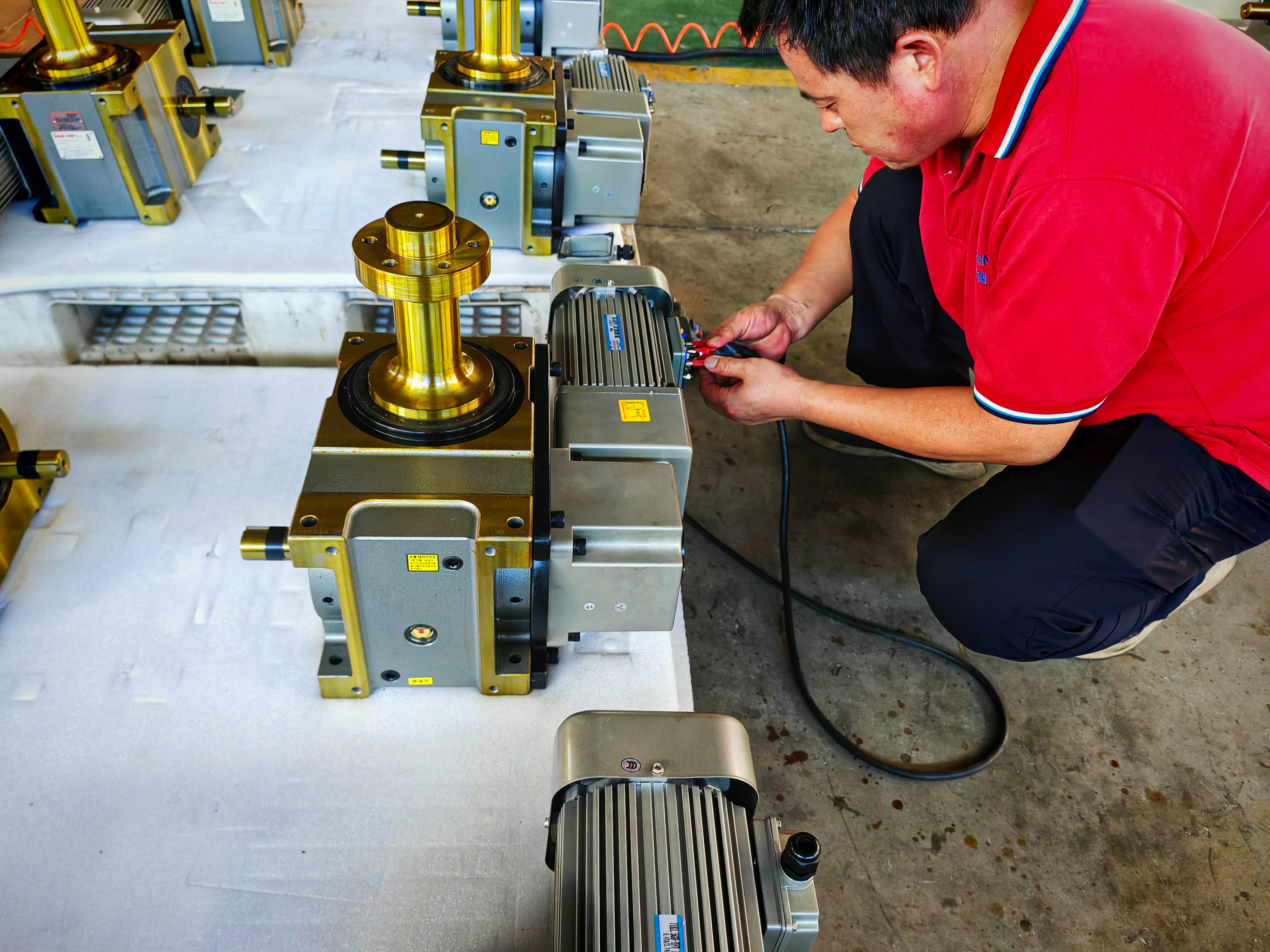
Liquid, paste, powder, and granule filling machines use cam indexers to rotate containers between filling nozzles, capping chucks, and labeling heads. A hollow flange output (DFH) is often useful when filling pipes must pass through the center. In the packaging scenario documented by HONEPAN, the matched equipment configuration was motor + reducer + induction cam + induction switch, with a 270/90 operation mode.
Pharmaceutical and Medical Packaging
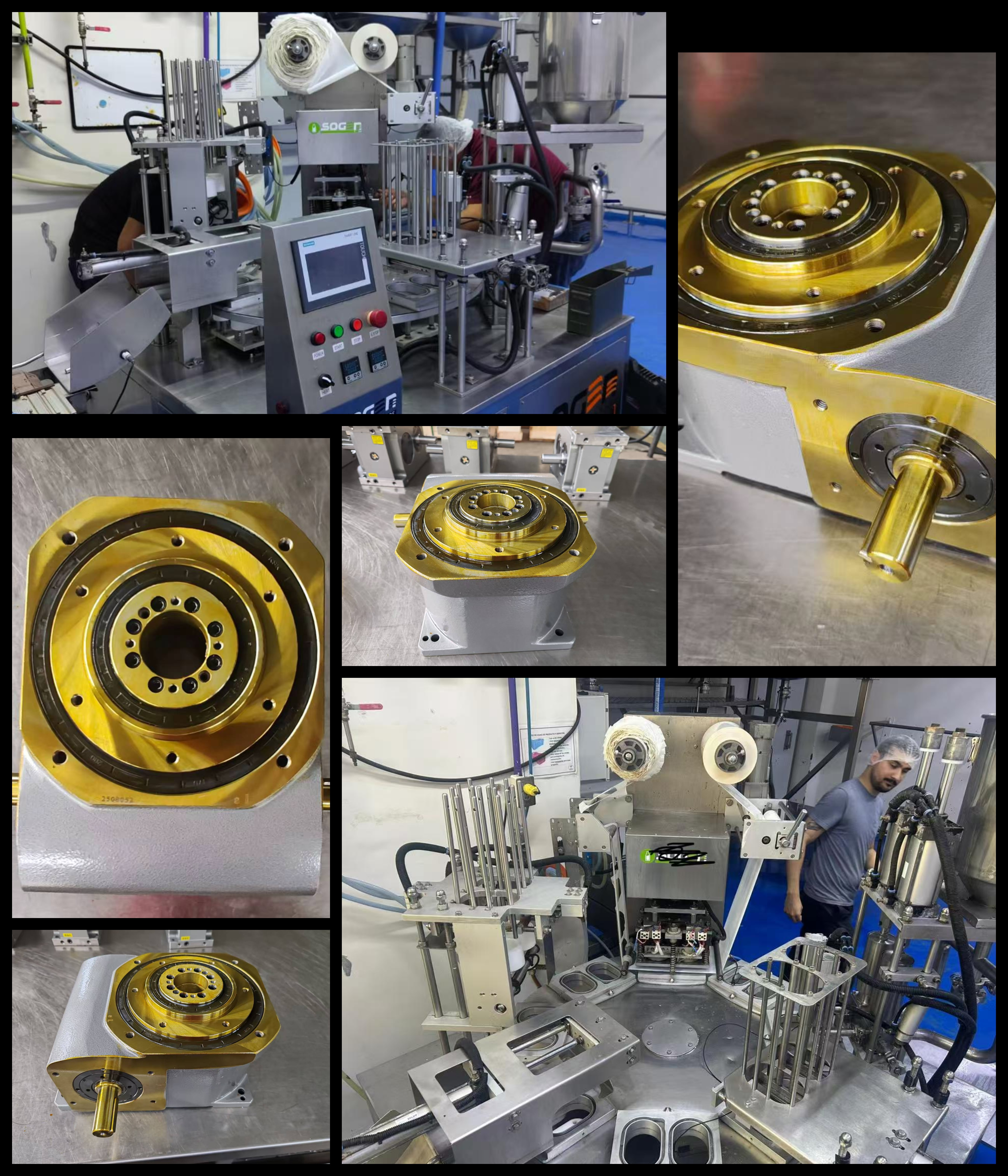
Pharmaceutical and medical packaging machinery includes oral liquid filling machines, eye drop filling machines, capsule filling machines, pharmaceutical cartoning machines, syringe assembly machines, indwelling needle assembly machines, glass bottle ink printing machines, and capsule making machines. In one customer case, a pharmaceutical and packaging equipment manufacturer ordered 10 HONEPAN cam indexers for motion indexing, control, power transmission, and support. The units operated for 7–12 years, performed well, and directly replaced damaged indexers. The customer recognized the performance and placed repeat orders.
Rotary Assembly Turntables
Assembly machines use cam indexers to move fixtures through multiple workstations. DT table output provides a direct table mounting surface, while DA ultra-thin table output reduces vertical space in compact assembly machines. High-speed assembly lines benefit from the stable indexing motion, reinforced by the self-locking property of the cam mechanism during positioning.
Welding and Heavy-Duty Positioning
Automotive welding lines, positioners, and heavy-duty rotary tables need high torque and rigid table support. The BT barrel cam heavy-duty table output series is designed for this class of applications, with model sizes up to 500BT.
Conveying and Parallel Indexing
Conveying systems and transfer machines often use the parallel-type cam indexer. The P series, with 1–16 stations and 90°–360° indexing angles, is a reasonable fit for applications where workpieces move in-line between stations rather than on a large turntable.
Comparison: Cam Indexer Series by Application Fit
| Series | Output Type | Model Range | Stations | Indexing Angle | Typical Scenario |
|---|---|---|---|---|---|
| DS | Shaft | 32DS–200DS | 2–196 | 60°–360° | Shaft-driven transmission, gear/pulley connection |
| DF | Flange | 38DF–350DF | 2–196 | 60°–360° | Rotary machines, filling and packaging lines |
| DFH | Hollow flange | 45DFH–250DFH | 2–196 | 60°–360° | Filling/capping lines needing central passage |
| DFS | Shaft + flange | 45DFS–250DFS | 2–196 | 60°–360° | Combined shaft drive and flange mounting |
| DT | Table | 80DT–350DT | 4–196 | 90°–360° | Rotary turntables, assembly and inspection stations |
| DA | Ultra-thin table | 70DA–450DA | 4–196 | 180°–270° | Compact/high-speed turntables, low machine height |
| BT | Barrel cam heavy-duty table | 130BT–500BT | 4–196 | 180°–270° | Heavy tables, welding positioners, large fixtures |
| DB | Cylinder-type | 80DB/130DB/160DB/180DB | 4–196 | 90°–360° | Compact cylindrical machine layouts |
| HBY | Cylindrical cam flange | HBYS/HBYZ | 4–196 | 180°–360° | Cylindrical cam drive with flange output |
| P | Parallel | P50–P320 | 1–16 | 90°–360° | Conveying and parallel indexing systems |
Note: Positioning accuracy across most series is ±30 arcsec; repeat positioning accuracy is ±10 arcsec or tighter, with model-dependent variation. The P series offers ±60 arcsec positioning accuracy.
Frequently Asked Questions
1. Which cam indexer type should be used for a liquid filling machine?
Liquid filling machines commonly use rotary turntables, so flange output (DF), hollow flange (DFH), table output (DT), or ultra-thin table output (DA) series are more suitable than shaft output types because they directly support the turntable or fixture. If pipes or cables need to pass through the center, DFH hollow flange is the practical choice. HONEPAN cam indexers are suitable for liquid filling machines, paste filling machines, powder filling machines, and a wide range of packaging and processing machinery.
2. When should I choose a hollow flange (DFH) cam indexer?
Choose a hollow flange (DFH) series when the machine requires a center opening for pneumatic lines, electrical cables, product pipes, or a central shaft. Typical applications include beverage filling, edible oil filling, bottled water production lines, pharmaceutical liquid filling, filling-and-capping machines, and labeling/filling combinations. DFH models range from 45DFH to 250DFH with 2–196 stations and indexing angles from 60° to 360°.
3. Which cam indexer series is better for a high-speed rotary assembly turntable?
For a rotary assembly turntable with speed and compactness requirements, the DA ultra-thin table output series (70DA–450DA) is often selected because it reduces vertical space and supports high-speed indexing with a 180°–270° indexing range. The DT table output series (80DT–350DT) is another standard option for direct table mounting. For heavy assemblies or larger diameters, evaluate the BT barrel cam heavy-duty table output series up to 500BT.
4. How do I determine the number of stations and the indexing angle for a project?
Start from the machine cycle. The number of stations equals the number of positions where work must stop in one full rotation. The indexing angle is the portion of the input cycle used for motion; the remaining time is dwell. For example, a packaging machine running 270° dwell and 90° indexing uses a 3:1 dwell-to-index ratio. HONEPAN standard series cover 2–196 stations; the parallel P series covers 1–16 stations. Indexing angles range from 60° to 360° depending on the series.
5. Can HONEPAN customize a cam indexer for non-standard project parameters?
Yes. HONEPAN provides OEM/ODM services with customization of specifications, parameters, materials, appearance, craftsmanship, and quality inspection reports. Monthly production capacity is 5,000 units, standard lead time is 4–15 days, and the minimum order quantity is 1 unit. All units are 100% tested before delivery. To discuss a non-standard project, send your drawings, load conditions, or required cycle time to the HONEPAN engineering team for a technical evaluation.
6. How long can a HONEPAN cam indexer last in continuous packaging or filling operation?
Service life depends on load, cycle frequency, lubrication, and environmental conditions. In one documented pharmaceutical and packaging machinery case, 10 HONEPAN cam indexers operated for 7–12 years and directly replaced damaged indexers while performing well. The use of hardenable alloy steels such as 42CrMo, 40Cr, 20CrMnTi, and 18CrMoV contributes to the wear resistance and long-term stability of the indexing unit.
Conclusion
Cam indexer selection is an application-matching process. Defining the station count, indexing angle, output type, precision grade, and service environment first will always produce a more reliable machine layout than starting with a brand name or a price target.
HONEPAN offers a broad range of cam indexer output types — shaft, flange, hollow flange, shaft-and-flange, table, ultra-thin table, heavy-duty barrel cam, cylinder-type, cylindrical cam flange, and parallel — with station counts from 1 to 196 and indexing angles from 60° to 360°. The company combines this range with a monthly capacity of 5,000 units, typical lead time of 4–15 days, an MOQ of 1, OEM/ODM customization, and 100% testing, making it possible to support both standard replacement orders and project-specific adaptations.
For more technical details, download the HONEPAN cam indexer brochure (PDF), or contact the HONEPAN engineering team with your machine parameters, station count, and load conditions for a project-specific recommendation.
Have Questions or Need More Details?
Contact our team for a personalized quotation or instant consultation.
Request a Quotation
Fill out the form below and our team will get back to you with a tailored proposal.
WhatsApp Direct Chat
Prefer to chat in real-time? Message us on WhatsApp for instant assistance & quick answers.
- Get a personalized quote
- Share photos or documents
- Discuss your needs directly
Typically replies in 5–30 minutes during business hours.