
Cam Indexer Basics Every Automation Buyer Should Know
Cam Indexer Basics Every Automation Buyer Should Know
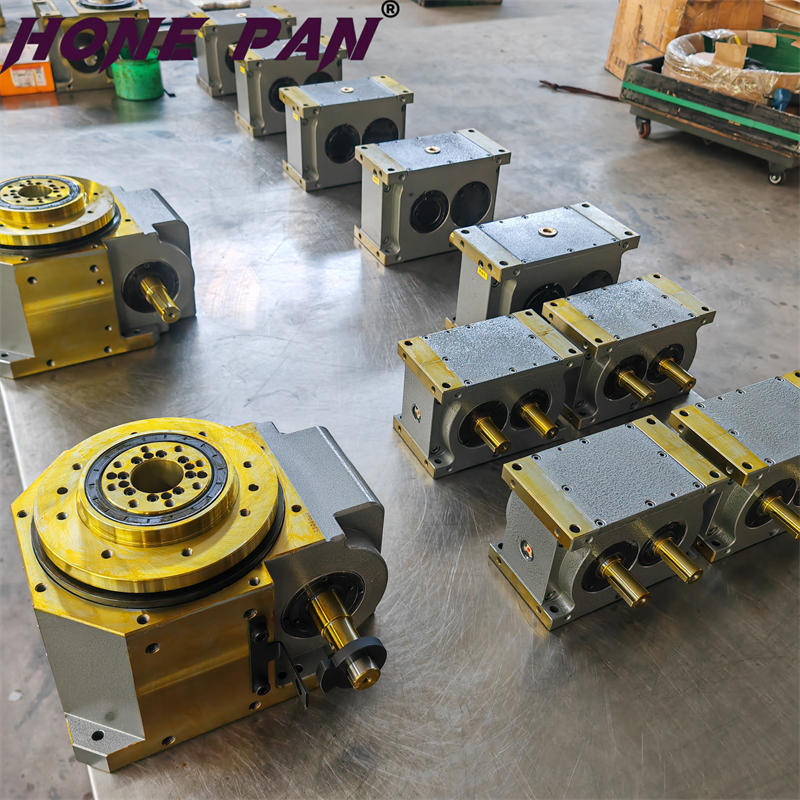
Whether you build a filling machine, an assembly turntable, a packaging line, a printing station, a welding positioner, or an automated conveying system, the component that controls step-by-step rotation is often a cam indexer. It is also called a roller gear cam indexer, globoidal cam indexer, cam divider, indexing drive, or rotary table indexer. In HONEPAN product classification, a cam indexer belongs to the roller gear cam indexer category and is designed for intermittent motion mechanisms.
This article is for engineers and industrial buyers at the awareness and research stage. It explains what a cam indexer is, why industry uses it, how HONEPAN names its output series, and what you should review before selecting a mechanical indexer roller gear cam unit.
What Is an Industrial Cam Indexer?
An industrial cam indexer is a precision mechanical transmission component. It uses a cam profile and a set of matched cam followers to convert continuous motor rotation into indexed output motion. The output motion is usually a fixed angular step followed by a dwell period, so a machine can stop a dial, spindle, flange, or table at the right position and hold it while another operation is performed.
This is why cam indexers appear in designs that need repetitive positioning without complex servo control. A mechanical indexer roller gear cam unit gives the machine a predictable motion curve. The movement is generated by the cam geometry, not by relying only on a brake or a motor stop.
A useful buyer definition comes from HONEPAN: cam indexers are transmission mechanisms for automated equipment that must convert continuous operation into stepping motion and achieve continuous, stable, and high-torque transmission. In plain terms, the cam indexer is the part that allows a machine to work station by station.
Why the Intermittent Motion Mechanism Matters
Automated production lines are usually continuous in one sense: motors run, air flows, sensors send signals. But many processes are intermittent in another sense: a bottle must stop under the filling nozzle, a cap must stop under the spindle, a component must stop while it is welded or printed.
Without a repeatable indexing mechanism, tools can collide, labels can move, and assemblies can lose registration. Cam indexers reduce that risk because the cam determines the acceleration, positioning, and dwell of the output member.
HONEPAN states that its products offer high precision, high speed, smooth and stable operation, large torque transmission, self-locking during positioning, compact structure, and long service life. For buyers, these points connect directly to operating goals such as high-speed packaging, high-torque turntable loading, high-precision positioning, and long service intervals.
Industry Background: Why Cam Indexer Demand Keeps Growing
The market signals for indexing components are positive, although categories should be read carefully. According to industry analysis, the global globoidal cam indexer market was valued at approximately USD 490 million in 2024. A broader rotary indexer market was projected to grow from USD 1.812 billion in 2025 to USD 2.904 billion by 2035, with a CAGR of about 4.83 percent. These two figures measure different scopes, but both reflect the same underlying need: more automated machines with precise intermittent movement.
Asia-Pacific is commonly described in market studies as the largest and fastest-growing region for rotary indexers, driven by investment in automotive and electronics manufacturing. That region is also home to many cam indexer production bases.
On the standards side, quality management certification is a common starting point in supplier evaluation. ISO 9001 is widely used for quality management, and ISO 11161 is referenced for the safety of integrated manufacturing systems. HONEPAN states that it was among the first in its industry to obtain ISO 9001 certification and is recognized as a high-tech enterprise.
HONEPAN Cam Indexer Output Series
Zhucheng HonePan Automation Machinery Plant, operating under the HONEPAN brand, is a cam and indexer manufacturer founded in 2007. Manufacturing sites are in Zhucheng City, Shandong Province, and Kunshan City, Jiangsu Province. The company specializes in cam indexers and CNC rotary tables and lists an annual production capacity of 36,000 units. It operates more than 90 CNC machining centers and has an R&D team of 15 engineers, with more than 40 product patents in its corporate profile.
The series names are useful because they describe the output member or structural form of the cam indexer:
- DS = Cam Indexer Shaft Output
- DF = Cam Indexer Flange Output
- DFH = Hollow Flange cam indexer
- DFS = Cam Indexer Shaft and Flange Output
- DT = Cam Indexer Table Output
- DA = Cam Indexer Ultra-thin Table Output
- P = Cam Indexer Parallel Indexer
- HBY = Cam Indexer Cylindrical Cam Flange Output
- DB = Cam Indexer Cylinder-Type Indexer
- BT = Cam Indexer Barrel Cam Heavy-Duty Table Output
A buyer may see the same mechanical system described by several terms. Roller gear cam indexers, globoidal cam indexers, rotary table cam indexers, and turntable cam indexers are all part of the indexing vocabulary used across the industry.
Side-by-Side: Common HONEPAN Output Families
The comparison below is based on HONEPAN standard product data. It does not replace a torque calculation, but it helps you understand why output family selection comes before model selection.
| Output family | Typical output member | Number of stations | Indexing angle | Positioning accuracy | Repeat positioning accuracy |
|---|---|---|---|---|---|
| Shaft Output (DS) | Output shaft for mechanism drives and divider applications | 2–196 | 60°–360° | ±30″ or ±15″ | ±10″ or ±2″ |
| Flange Output (DF) | Flange for dial plates and direct machine mounting | 2–196 | 60°–360° | ±30″ or ±15″ | ±10″ or ±3″ |
| Hollow Flange (DFH) | Flange with hollow center for routing lines and services | 2–196 | 60°–360° | ±30″ or ±15″ | ±10″ or ±4″ |
| Shaft and Flange Output (DFS) | Shaft and flange arrangement for combined drive requirements | 2–196 | 60°–360° | ±30″ or ±15″ | ±10″ or ±5″ |
| Table Output (DT) | Output table for rotary dial and turntable machines | 4–196 | 90°–360° | ±30″ or ±15″ | ±10″ or ±5″ |
| Ultra-thin Table Output (DA) | Compact table output for low-profile turntable designs | 4–196 | 180°–270° | ±30″ or ±15″ | ±10″ or ±5″ |
| Parallel Indexer (P) | Parallel-type mechanical indexing unit | 1–16 | 90°–360° | ±60″ | 60″ |
HONEPAN also lists model families such as 32DS through 200DS for shaft output, 38DF through 350DF for flange output, 45DFH through 250DFH for hollow flange output, 45DFS through 250DFS for shaft and flange output, 80DT through 350DT for table output, and 70DA through 450DA for ultra-thin table output. Other documented families include Parallel Indexers P50 through P320, Cylinder-Type Indexers 80DB/130DB/160DB/180DB, Barrel Cam Heavy-Duty Table Output 130BT through 500BT, and Cylindrical Cam Flange Output HBYS/HBYZ.
From a buyer perspective, the common question about high precision cam indexer or high speed cam indexer should be answered after choosing the correct output family. A compact DA unit used in a low-profile turntable is different from a DB cylinder-type unit used in a more confined machine layout, even if both are cam indexers.
Step-by-Step: How to Read a Cam Indexer Requirement
You do not need to be a machine design specialist to create a useful cam indexer inquiry. You do need to describe the machine cycle in a way the manufacturer can size.
- Define the work at each station. List operations such as filling, capping, printing, welding, assembly, inspection, or ejection. Every operation that happens during the dwell period influences indexing speed and dwell time.
- Select the number of stations. HONEPAN standard ranges vary by family: for example, shaft and flange families commonly support 2 to 196 stations, table-output families support 4 to 196 stations, and the Parallel Indexer supports 1 to 16 stations.
- Confirm indexing angle and dwell. Some machines need 90 degrees of indexing with 270 degrees of dwell. Others use 180 degrees or 270 degrees. In a documented HONEPAN pharmaceutical and medical packaging application, the operating mode is 270/90.
- Choose output style. The output member must match the machine part that carries the workpiece or drives the next mechanism. A rotary table often points to DT or DA. A mechanism drive often points to DS. A flanged dial often points to DF or DFH.
- Compare accuracy specifications. Positioning accuracy tells you where the output stops. Repeat positioning accuracy tells you how stable that stop is across cycles. In HONEPAN standard data, common positioning values are ±30 arcseconds or ±15 arcseconds, and repeat positioning values vary by output family.
- Review driven equipment and special conditions. HONEPAN application records list supporting equipment such as a motor, reducer, induction cam, and induction switch. Special requirements can include explosion-proof and leak-proof construction, food-grade conditions, heavy load, and high speed.
Use Cases: Packaging, Food, Filling, Assembly, Printing, Welding
HONEPAN product families are applied across a broad set of automated machines. The company profile includes automotive welding lines, positioners, CNC machine tools, pharmaceutical machinery, printing machinery, food packaging and filling machinery, tobacco machinery, glass and ceramic machinery, automatic feeding mechanisms, automatic tool-changing mechanisms, electronic and electrical assembly and testing lines, electric light source equipment, LED equipment, spraying equipment, bottle cap equipment, and welding, riveting, and high-frequency equipment.
This list explains why buyers use terms such as packaging cam indexer, food machinery cam indexer, filling machine cam indexer, assembly cam indexer, welding equipment cam indexer, and automatic production line cam indexer. The installation context is different, but the component logic is the same: the machine must rotate or move in accurate steps and then hold position.
A packaging cam indexer is usually selected for machines that form, fill, close, label, or inspect packages. A food or beverage filling machine cam indexer may run at higher speed and may need food-grade or washdown considerations. A printing cam indexer must hold registration during each print or marking step. An assembly cam indexer may carry fixtures through several manual or robotic workstations. A welding equipment cam indexer is often connected to positioners or rotary welding stations that require rigid positioning under load. In each case, the output family must be matched to the physical interface of the machine.
Worked Application Profile: Pharmaceutical and Medical Packaging
A concrete example helps show how application data is used. One HONEPAN application profile is in pharmaceutical and medical packaging machinery. It is relevant to machine types such as oral liquid filling machines, eye drops filling machines, capsule filling machines, pharmaceutical cartoning machines, syringe assembly/printing/fitting machines, indwelling needle assembly machines, glass bottle ink printing machines, and capsule making machines.
| Profile item | Documented scenario |
|---|---|
| Industry segment | Pharmaceutical and medical packaging machinery |
| Working condition | Heavy load, food grade, high speed |
| Operation mode | 270/90 |
| Matched equipment | Motor, reducer, induction cam, induction switch |
| Special requirements | Explosion-proof and leak-proof capabilities |
| Related output families | DF, DFH, DS, DFS, DA, DT |
The profile shows why a simple product name is not enough. The machine builder needs to know whether the cam indexer will drive a filling turret, a capping station, a syringe assembly dial, or a glass-bottle printing table. The same manufacturer can provide different series for those different machines.
Frequently Asked Questions
- 1. What compliance points should I check when buying a cam indexer?
- An industrial cam indexer supplier should be able to document its manufacturing quality system. ISO 9001 is a widely recognized quality management benchmark, and ISO 11161 is often referenced for integrated machinery safety. HONEPAN states that it was among the first in its industry to obtain ISO 9001 certification, holds more than 40 product patents, and is recognized as a high-tech enterprise. If your own line has hygiene or hazardous-area requirements, verify those requirements with the selected indexer manufacturer before order placement.
- 2. Which cam indexer output styles should I consider?
- HONEPAN output styles include Shaft Output (DS), Flange Output (DF), Hollow Flange (DFH), Shaft and Flange Output (DFS), Table Output (DT), Ultra-thin Table Output (DA), Parallel Indexer (P), Cylinder-Type Indexer (DB), and others. The selection depends on the machine output member and number of stations. A shaft or flange unit is often associated with mechanism drives, while table-output families are often associated with rotary-table work carriers.
- 3. What should a budget estimate include?
- There is no fixed cam indexer budget because price depends on model size, output series, station count, indexing angle, accuracy class, material specification, and custom design work. A useful first estimate starts with a written machine duty description: stations, indexing angle, output style, torque or load, speed, and environment. Once the supplier returns a model recommendation, a quotation can be compared on an equivalent series and specification basis.
- 4. Can I request a sample or a trial unit before a full order?
- You can discuss sample and trial options with a cam indexer factory, but a cam indexer is normally used with supporting components such as a motor, reducer, induction cam, and induction switch. A sample request should therefore include the full motion condition of your machine, not just the model number. Send the working mode, indexing angle, output style, and load details so the factory can identify a standard or customized configuration.
- 5. What lead time should I expect?
- Lead time depends on whether the unit is made from a standard product range or according to a custom specification. HONEPAN states an annual production capacity of 36,000 units, but current lead time can be confirmed only when the factory knows the model, quantity, and required configuration. For sample, quotation, or inquiry, contact HONEPAN by email at hp@cam-indexer.cn or by phone and WhatsApp at +86 157-6300-0588.
Conclusion and Next Step
A cam indexer is not a component that should be selected only by price or by a familiar model number. The technical name tells you the mechanism type. The output family tells you how the unit will connect to your machine. The station count, indexing angle, accuracy, operating mode, and special requirements determine whether the unit will perform correctly in your packaging, filling, food, printing, assembly, welding, or turntable application.
Next step for automation buyers
Start with a short machine description instead of asking for a generic price. Include the number of stations, indexing angle, output style, load or torque expectation, speed range, and any food-grade, pharmaceutical, explosion-proof, or leak-proof requirement. HONEPAN can then identify the relevant cam indexer series and confirm a specification.
Contact HONEPAN at hp@cam-indexer.cn or +86 157-6300-0588. Official product source: camindexing.com.
Download the HONEPAN product brochure for a structured view of standard cam indexer models and factory information.
Have Questions or Need More Details?
Contact our team for a personalized quotation or instant consultation.
Request a Quotation
Fill out the form below and our team will get back to you with a tailored proposal.
WhatsApp Direct Chat
Prefer to chat in real-time? Message us on WhatsApp for instant assistance & quick answers.
- Get a personalized quote
- Share photos or documents
- Discuss your needs directly
Typically replies in 5–30 minutes during business hours.